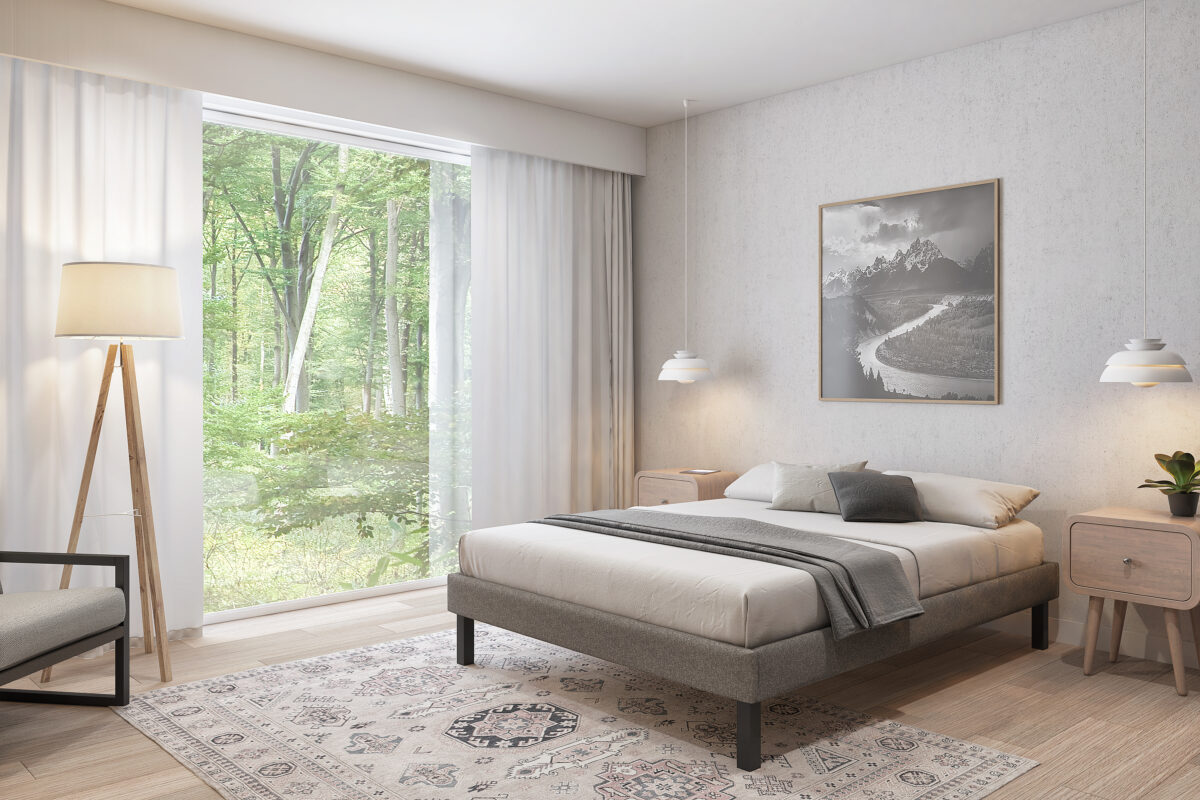
Pets at Home: How to Choose a Bed That’s Easier to Live With Every Day

Living with a pet quietly changes a home. A dog that follows the family’s rhythm, a cat that chooses its own favourite spots, fur that appears in places you were sure you had just vacuumed: these small everyday details can have more influence than we think when choosing furniture.

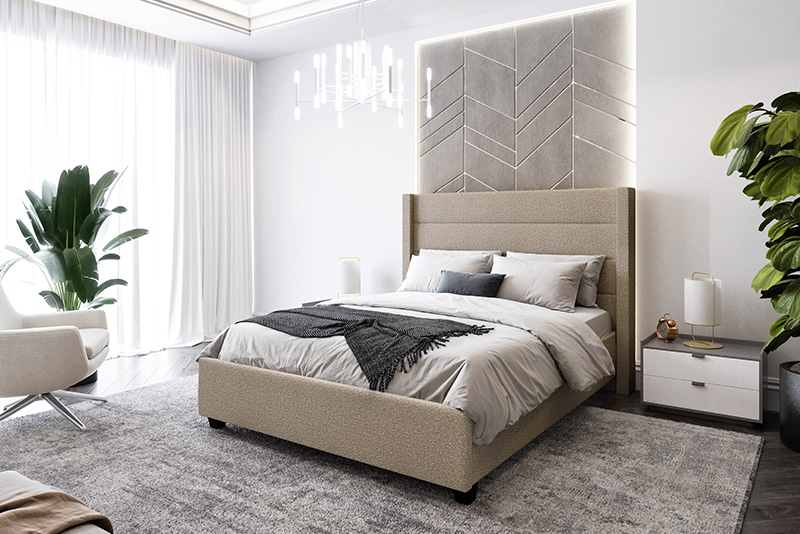
In the bedroom, the bed plays a central role. It structures the room, sets the tone for the decor and supports daily habits. When a pet shares the home, certain criteria become even more important: maintenance, durability, height, fabrics and the space around the bed.

It is not about choosing a bed only “for” your pet. It is about choosing a bed that remains beautiful, comfortable and easy to live with in a home where real life also moves on four paws.

Think About Maintenance From the Start

When choosing a bed, we often think about style first: the colour, the shape, the headboard, the finish. With a pet at home, maintenance should also be part of the first considerations.

Fur, dust and small everyday marks can quickly accumulate around the bed. A model that is easier to clean helps keep the bedroom pleasant without feeling like everything needs to be protected at all times.

Before making a choice, it can be useful to ask a few questions:

  • Will the space under the bed be easy to reach with a vacuum?
  • Are the sides of the bed likely to collect fur?
  • Will the headboard be easy to dust?
  • Will the chosen colour be demanding in everyday life?
  • Is the fabric or surface likely to show marks quickly?

These details are not always the first to catch our attention, but they are often what makes the difference after a few months of use.

Choose a Colour That Is a Little More Forgiving

Very light colours can create a fresh, bright look. Very dark colours, on the other hand, can create a chic and enveloping effect. But in a home with a pet, both extremes can be more demanding.

A white, cream or very light fabric may show marks more quickly, especially if a dog likes to lie near the bed after being outside. Conversely, a very dark fabric can make light-coloured fur and dust stand out.

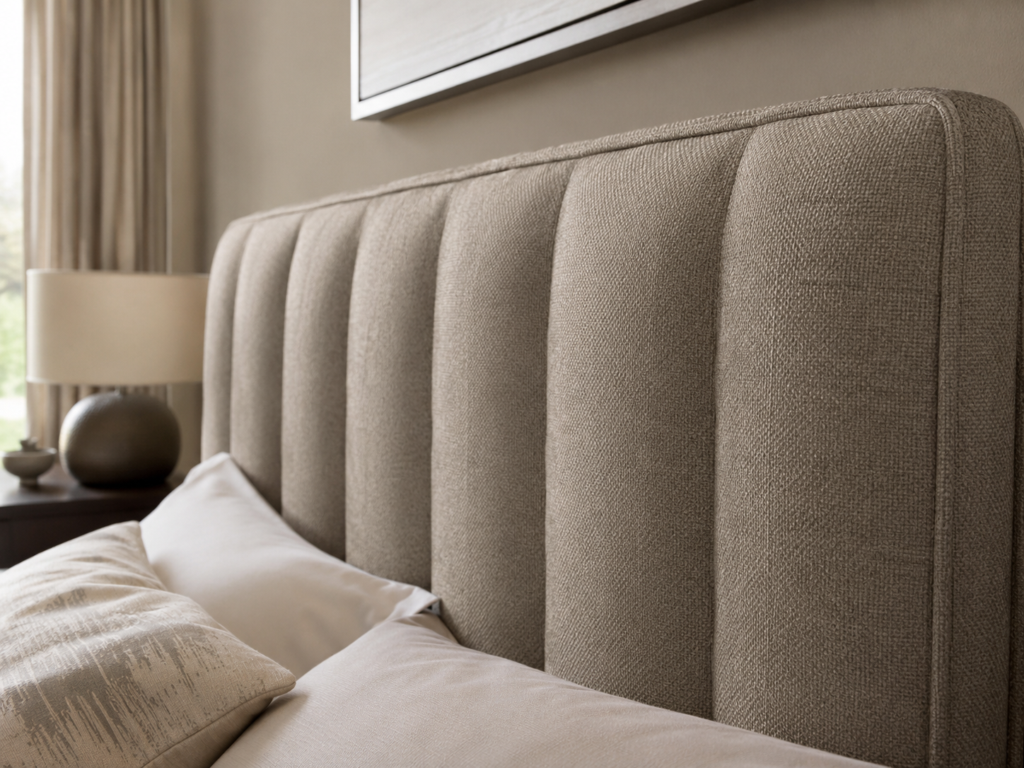
Mid-tone colours are often easier to live with. A textured beige, a soft grey, a taupe, a warm brown or a slightly heathered shade can better handle the small marks of daily life. They do not replace cleaning, of course, but they can help prevent every hair from becoming a visual event.

Texture also plays a role. A slightly textured fabric can add depth to the bedroom while being more forgiving than a perfectly solid surface.
Pay Attention to Fabrics and Textures

Not all fabrics react the same way to pets. Some hold fur more easily. Others may be more sensitive to claws, rubbing or small snags.

For an upholstered bed, it is best not to choose with your eyes alone. A fabric can look beautiful in a photo, but be less suited to a home where a cat likes to stretch near the bed or where a dog often rubs against furniture.

A good choice should take three elements into account:

  1. Ease of cleaning
    Can the fabric be dusted or vacuumed easily?
  2. Everyday resistance
    Does the surface seem fragile, very delicate or likely to snag?
  3. Visual tolerance
    Does the fabric help soften the appearance of fur, light marks or dust?

The goal is not to find an indestructible bed. No piece of furniture truly is. The idea is to choose a finish that fits your lifestyle, so the bed remains pleasant without requiring constant vigilance.

Consider the Height of the Bed

The height of the bed influences the look of the bedroom, but it can also change everyday life with a pet.

A very high bed can be less practical for a small dog, an older pet or an animal that often jumps on and off the bed. Repeated jumps can become more difficult over time, especially for smaller or less agile pets.

On the other hand, a very low bed can create a beautiful sense of simplicity, but it may also make cleaning around the bed less convenient depending on its design. If the space under the base is very limited, dust and fur can accumulate more easily.

The right choice depends on the pet, its habits and how you use the bedroom. If your dog always sleeps on the floor, the height may matter less. If your cat moves across the bed as though it were a co-owner, the question becomes more concrete.

Avoid Areas That Are Difficult to Clean

Some beds are beautiful, but include details that make maintenance more complicated: highly sculpted legs, narrow spaces, bases that sit almost directly on the floor, deep seams, fabric that extends very low or shapes that create small hard-to-reach corners.

In a home with pets, these areas can quickly become fur traps. They require more time and more patience when cleaning.

A bed with simpler lines can be a better ally. That does not mean choosing a model without character. A well-designed headboard, a refined base or a rich fabric can create a strong visual effect without multiplying the places where dust can settle.

The most practical design is not always the most minimalist. It is the one that finds the right balance between style, comfort and ease of maintenance.

Think Realistically About Integrated Storage

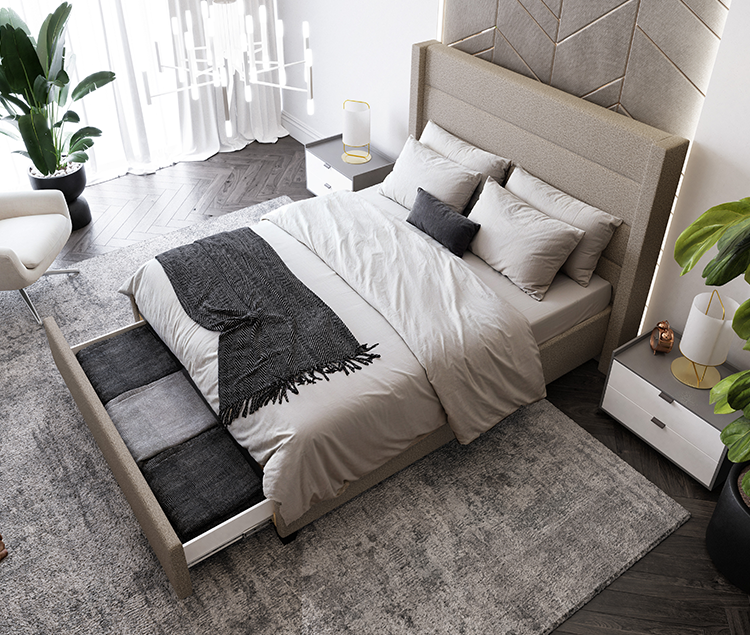
A bed base with storage can be very useful in a bedroom. It helps free up space, reduce clutter and store items that are used less often. In a home with pets, this can be an interesting advantage: fewer objects on the floor often means less accumulated dust and an easier room to clean.

That said, integrated storage must remain practical. Before choosing a base with drawers, it is important to make sure the space around the bed allows them to open easily. It is also worth thinking about maintenance around the openings, especially if fur tends to gather in corners.

Storage can help, but it must suit the room. In a small bedroom, an inaccessible drawer quickly becomes more frustrating than useful.
Create a Clear Zone Around the Bed

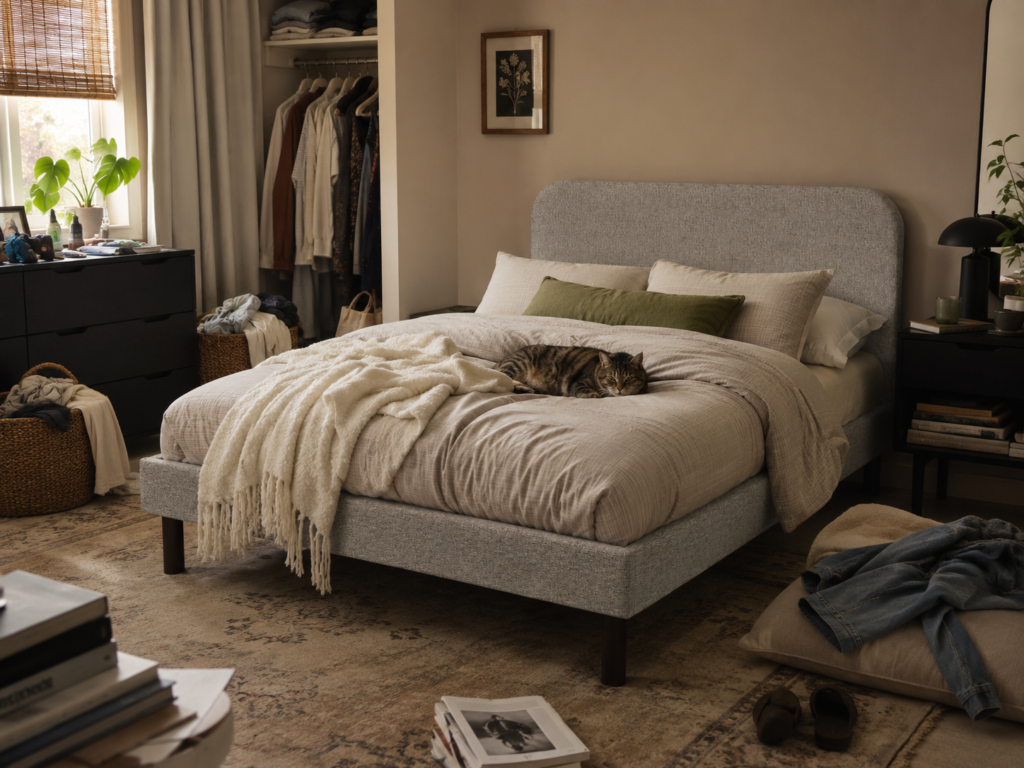
Pets often like pathways and comfortable corners. If the space around the bed is very cluttered, it can become harder to move around, clean and keep the bedroom organized.

A clear zone around the bed makes cleaning easier and helps the room feel more pleasant. It also allows your pet to move around without catching on furniture, blankets or objects left on the floor.

There is no need to create a perfectly empty bedroom. A few adjustments can be enough: choosing properly proportioned nightstands, avoiding too many baskets on the floor, leaving a clear passage on one side of the bed, or creating a specific spot where your pet can rest.

A washable rug, a dog cushion or a small area near the bed can also help create a simpler routine, especially if your pet likes to stay close without necessarily getting on the bed.

Choose a Bed That Fits Your Real Life

A bed is not only a decorative element. It is a piece of furniture used every day, in a room that should remain pleasant, calm and easy to live in. With pets, the right choice is not necessarily the most delicate, the lightest or the most dramatic. It is the one that naturally fits your rhythm.

Before choosing, think about your daily life:

  • Does your pet often get on the bed?
  • Does it shed a lot?
  • Does it sleep in the bedroom?
  • Does it tend to scratch or rub against furniture?
  • Is the bedroom easy to clean?
  • Are you looking for a bed that is more decorative, more practical or a balance of both?

These questions help you choose more accurately. They can also help you avoid regretting a fabric that is too delicate, a colour that is too demanding or a base that is difficult to maintain.

A Beautiful, Durable and Easy-to-Live-With Bed

Having a pet does not mean giving up on a beautiful bedroom. It simply means that certain choices benefit from being made with a little more realism.

A well-chosen bed can remain elegant while being adapted to everyday life. It can have a beautiful presence in the room, withstand the habits of the home and make maintenance simpler rather than more complicated.

In a bedroom shared with a dog or a cat, comfort is not limited to appearance. It is also found in the details that make the room easier to live with: a well-chosen colour, an appropriate height, a less demanding surface, a clear space and a design that does not need to be watched constantly.

The right bed is the one that remains beautiful in a real home. Even when someone leaves a few hairs behind.


How to Choose a Mattress for Couples: Comfort, Movement and Firmness

Sleeping as a couple sometimes requires a few compromises. Your partner’s movements, different firmness preferences, body heat during the night and the amount of space available can all influence sleep quality. To choose the right mattress for a couple, it is important to compare support, motion isolation, mattress size, materials and durability.


What is the best mattress for a couple?
The best mattress for a couple is generally one that offers good motion isolation, stable support, a firmness level suited to both sleepers and enough surface area for each person to have their own space. Couples should also consider temperature regulation, mattress durability and compatibility with their bed base.

Why choosing a mattress is different when you sleep as a couple

Two people, two comfort preferences

Each sleeper may have different preferences: firmer, softer, more cushioning or more stable.

Movement during the night

When one person moves a lot, the other may feel it. Motion isolation therefore becomes an important criterion.

Heat and personal space

Sleeping as a couple can increase the feeling of warmth. Mattress size also plays a role in overall comfort.

The most important criteria for choosing a mattress for couples

Motion isolation

A good mattress for couples should limit motion transfer from one side of the bed to the other.

Firmness

A medium to balanced firmness can work well for many couples, but the right choice depends on preferences, body weight, sleep position and the level of support desired.

Support

The mattress should provide a stable and comfortable surface, both in the centre and around the edges.

Temperature regulation

Breathable materials can contribute to better comfort when two people share the same bed.

Durability

A couple generally places more pressure on a mattress than one person sleeping alone. The quality of the materials and construction therefore becomes important.

What mattress size should a couple choose?

Size Best for Things to consider
Full (54”) Small spaces or occasional use May feel limited for two adults
Queen (60”) Couples looking for a good balance between space and price Fits well in many bedrooms
King (78”) Couples who want more personal space Requires a larger bedroom


What if both sleepers have different preferences?

Compare sleep positions

A side sleeper may prefer more cushioning, while a back or stomach sleeper may look for more stability.

Look for balanced comfort

A mattress that is too firm for one person or too soft for the other can create an uncomfortable compromise.

Think about the bed base

A quality bed base can contribute to the stability, support and durability of the entire sleep setup.

Foam, hybrid or spring mattress: which is best for couples?

Mattress type Possible benefits What to watch for
Foam Good motion absorption, cushioning comfort May retain more heat depending on the materials
Spring  Good airflow, dynamic support May transfer more movement depending on the design
Hybrid Balance of support, comfort and ventilation Comfort varies depending on the quality of the layers


Common mistakes to avoid

  • Choosing based only on price.
  • Buying without comparing both sleepers’ preferences.
  • Overlooking the size of the mattress.
  • Forgetting the importance of the bed base.
  • Choosing too quickly without thinking about durability.

Frequently asked questions about mattresses for couples

What firmness should you choose for a couple’s mattress?

The best firmness depends on both sleepers. A balanced firmness can work well for many couples, especially when preferences are different.

Which mattress best reduces a partner’s movements?

A mattress designed to absorb movement well can help reduce disturbances caused by a partner changing positions during the night.

Is a Queen mattress enough for a couple?

Yes, a queen mattress can work well for many couples. A king mattress may be preferable if both people move a lot or want more space.

Is a hybrid mattress a good choice for two people?

A hybrid mattress can be an interesting choice for couples because it can offer a good balance of support, comfort and airflow.

When should you replace a mattress used by two people?

It may be time to replace a mattress when it loses support, shows visible sagging or no longer provides stable comfort.

What Your Bed Does While You Sleep (And Why It Changes Everything)

Your bed doesn’t just support you during the night. It manages pressure, heat, movement, and body alignment. If these elements aren’t properly controlled, your sleep becomes unstable, leading to micro-awakenings and less effective recovery.


You lie down. You find your position. And you fall asleep.

At that point, it feels like everything stops. But in reality, your bed goes to work.

For several hours, it interacts with your body, responds to your movements, and absorbs your heat… or traps it.

And that’s exactly what determines whether your sleep will be truly restorative or not.

Sleep is not static

We often think of sleep as a motionless state. But your body is constantly adjusting.

Why do you move during the night?
Because your body is trying to reduce discomfort.

Throughout the night, your body:

  • changes position
  • redistributes pressure
  • regulates temperature
  • moves through different sleep cycles

Your bed needs to follow these changes. Otherwise, your body compensates.

1. It manages (or fails to manage) pressure

Over time, certain areas carry more weight:

  • shoulders
  • hips
  • lower back

Why do some mattresses cause micro-awakenings?
Because they concentrate pressure instead of distributing it.

Result:

  • increasing discomfort
  • frequent repositioning
  • fragmented sleep

2. It accumulates (or dissipates) heat

Your body produces heat all night long.

Why do you feel hotter after a few hours of sleep?
Because some materials trap heat and limit airflow.

When heat builds up:

  • you move more
  • you partially wake up
  • deep sleep decreases

3. It reacts to every movement

You don’t stay still all night. Every movement creates a reaction.

A good sleep system:

  • absorbs movement
  • stays stable
  • limits disturbances

A poor one:

  • amplifies motion
  • forces your body to readjust

Why does this matter?
Because even unconsciously, your body is working to stabilize itself.

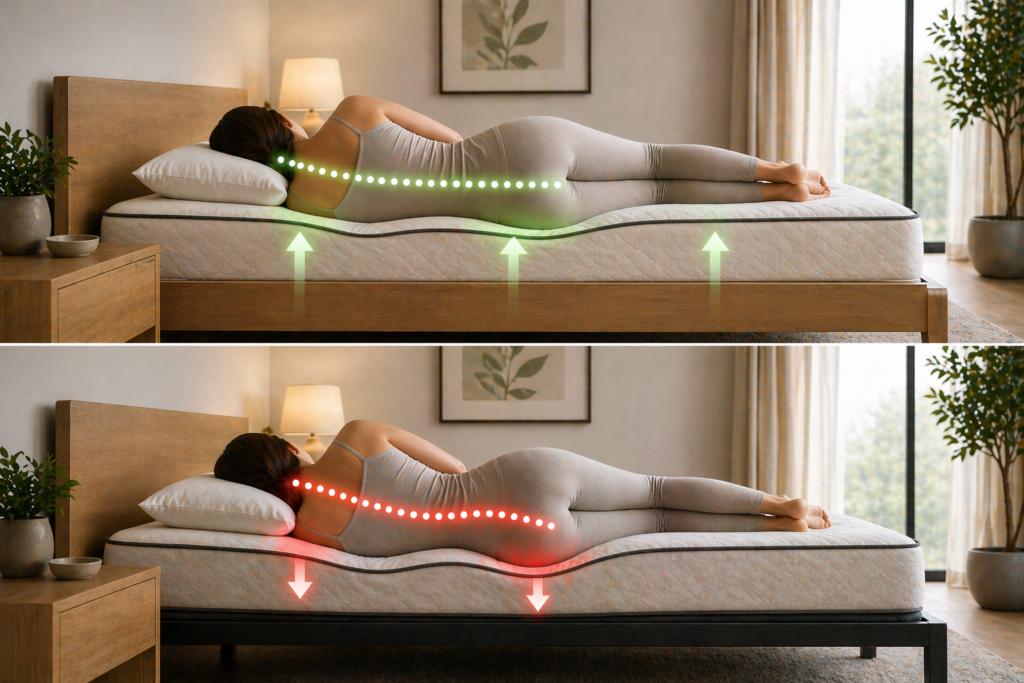
4. It maintains your alignment… or breaks it

Your position naturally shifts over time.

Why is alignment important during sleep?
Because poor support forces your muscles to compensate all night long.

Possible effects:

  • tension
  • discomfort
  • reduced recovery

5. It influences your surrounding environment

Your bed doesn’t function in isolation.

It works with:

  • the bed base
  • airflow
  • surrounding materials

A poorly ventilated mattress or inadequate base can trap heat and moisture.

A mattress needs to breathe to remain effective over time.

The challenge: everything happens gradually

Why does your sleep sometimes feel worse without a clear reason?

Because:

  • pressure slowly increases
  • heat builds up
  • comfort declines
  • micro-awakenings accumulate

Nothing is sudden. But everything adds up.

How to know if your bed is doing its job

Ask yourself:

  • Why do I move so much at night?
  • Do I feel warmer after a few hours?
  • Do I wake up without a clear reason?
  • Do I feel worse in the morning than when I went to bed?

If the answer is yes, your bed may not be supporting your body properly.

In summary

During the night, your bed:

  • distributes your weight
  • manages your temperature
  • absorbs your movements
  • maintains your alignment
  • influences your environment

It’s not passive.

It’s an active system working for hours.

And that’s often where the difference lies between an average night… and a truly restorative one.


FAQ

Why do I move so much during the night?

Usually due to discomfort related to pressure, heat, or support. Your body is trying to find a better position.

Is it normal to wake up without a reason?

Yes, but if it happens frequently, it may indicate an issue with comfort or your sleep environment.

Can a mattress affect deep sleep?

Yes. An inadequate mattress can cause micro-awakenings that prevent stable deep sleep.

Why do I feel hotter in the middle of the night?

Because body heat accumulates and some mattresses limit heat dissipation.

Does the bed base impact sleep quality?

Yes. It affects both support and airflow, which directly influence comfort and temperature.

Why You Overheat at Night (and How to Fix It)

Waking up drenched in sweat. Searching for the cool side of the bed. Flipping your pillow to find a hint of freshness.

If this sounds familiar, you’re not alone.

Nighttime overheating is one of the most common causes of disrupted sleep. And contrary to popular belief, it’s not just about room temperature. In many cases, the issue comes from the bed itself.

Why do you feel hot at night?

1. Your body naturally produces heat

During the night, your body temperature fluctuates. Certain sleep phases slightly increase heat, and your body tries to regulate it by releasing moisture.

If that heat gets “trapped,” discomfort sets in.

2. Your mattress materials retain heat

Some mattresses, especially those designed to feel very enveloping, can restrict airflow.

Result:

  • Heat builds up
  • Moisture gets trapped
  • The surface becomes warmer over time

Even if the mattress feels comfortable at first, it can become stifling during the night.

3. Poor bed ventilation

This factor is often overlooked, but it’s critical.

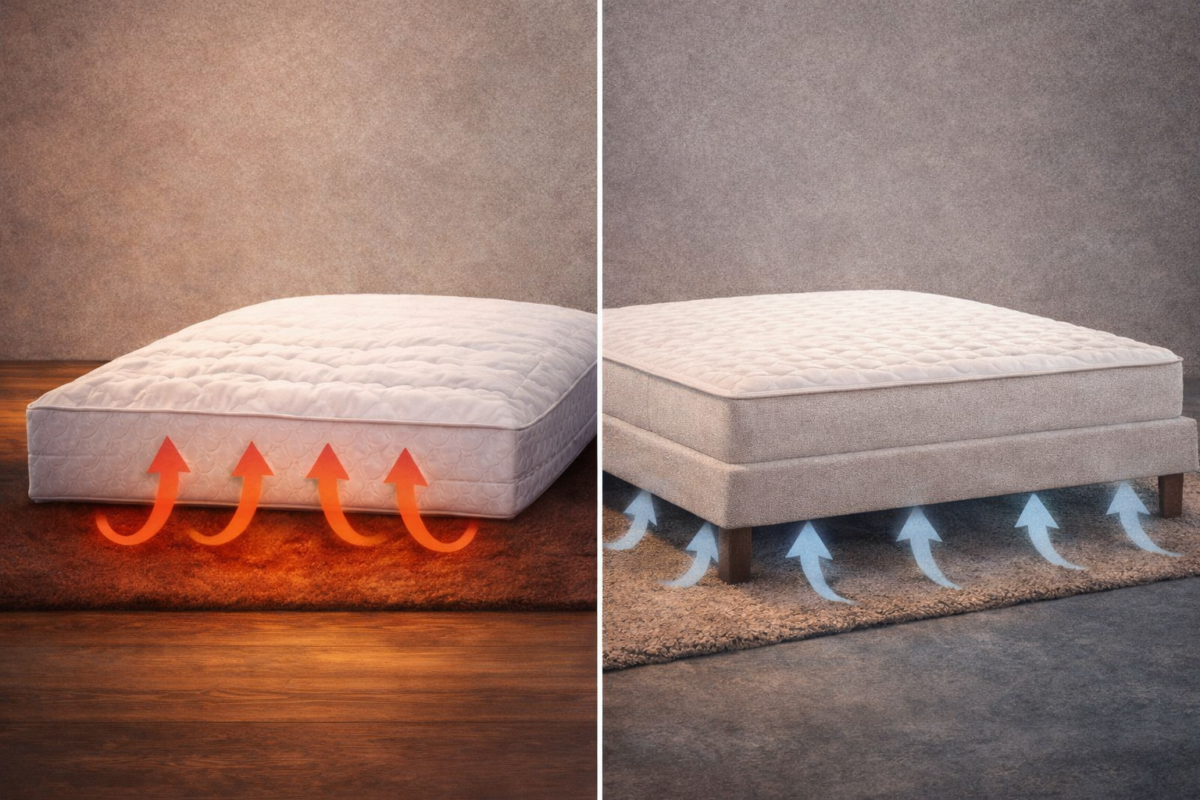
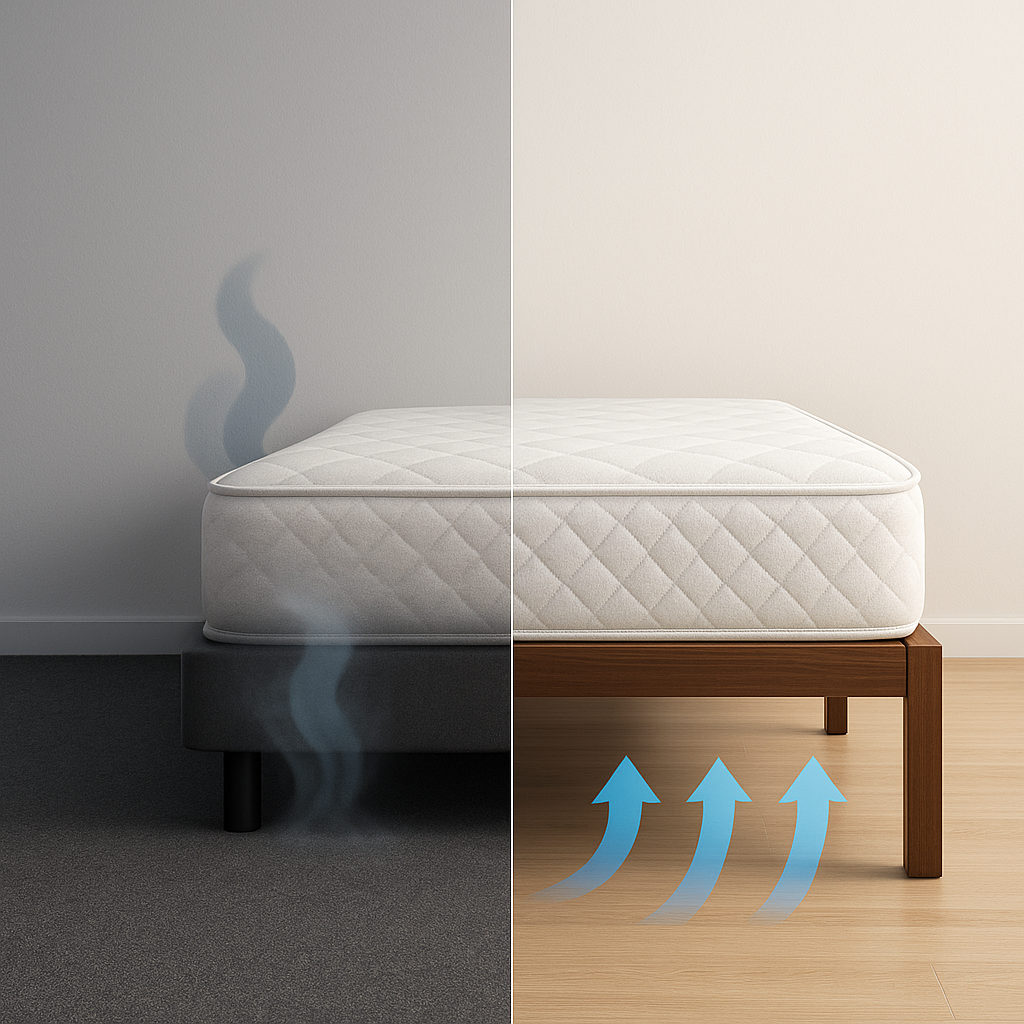
A mattress needs to breathe. If it sits too close to the floor or on an unsuitable base, airflow is limited, encouraging heat and moisture buildup.

4. Your bedroom environment

The ideal sleep setup is cool and dark.

A room that is too warm, poorly ventilated, or cluttered can amplify the feeling of heat, even with a good mattress.

Why heat disrupts your sleep

Sleeping in an environment that’s too warm is more than just uncomfortable.

It can lead to:

  • Frequent awakenings
  • Reduced deep sleep
  • Feeling tired upon waking
  • Less effective recovery

Your body needs to cool down slightly to fall asleep and stay asleep. When this process is disrupted, sleep quality suffers.

How to reduce heat at night

Here are the most effective levers, from simplest to more structural.

1. Adjust the room temperature

  • Aim for a cool room (around 16 to 18°C)
  • Air out the space before bedtime
  • Avoid direct heat sources near the bed

This is the foundation, but rarely enough on its own.

2. Choose breathable bedding

Sheets and textiles play a significant role.

Prioritize:

  • Natural fibers (cotton, linen)
  • Moisture-wicking fabrics
  • Seasonal bedding

3. Check your bed base

A well-designed base promotes airflow under the mattress, helping reduce trapped heat and moisture. Platform or well-ventilated bases typically offer a better balance between support and breathability.

4. Choose the right mattress

Not all mattresses handle heat the same way.

Consider:

  • Airflow capacity
  • How it responds to pressure (compression vs. distribution)
  • Materials used

A good mattress should not only feel comfortable at first, but remain temperature-stable throughout the night.

5. Optimize your overall environment

Good sleep depends on multiple factors:

  • A clean, uncluttered bedroom
  • Proper air circulation
  • A space dedicated to rest

Even simple elements like clutter or air quality can influence how warm you feel.

In summary

Overheating at night isn’t inevitable.

It’s often the result of an imbalance between:

  • Your body
  • Your mattress
  • Your bed base
  • Your environment

By adjusting these elements, you can regain a more stable, deeper, and more comfortable sleep.

Waking Up Tired: When the Problem Is Not the Number of Hours

You sleep 7, 8, sometimes even 9 hours. Yet you wake up exhausted, heavy, unfocused.

We often blame fatigue on a lack of sleep. But in many cases, the issue is not quantity, it is quality.

Understanding that difference can change how you approach your nights.

Sleeping Longer Does Not Mean Sleeping Deeper

Sleep happens in cycles, moving between light sleep, deep sleep, and REM.

Deep sleep is where physical recovery largely occurs. Muscles relax. Heart rate slows. The nervous system settles.

If these deeper stages are shortened or repeatedly interrupted, you may spend eight hours in bed without truly restoring your energy.

Small micro-awakenings, subtle discomfort, or constant repositioning can prevent full relaxation, even if you do not remember waking up.

Why You May Wake Up Tired Even After 8 Hours

Ongoing Stress

Mental tension does not always switch off at night. A busy period or high cognitive load can keep the body slightly alert.

You are asleep, but not fully at rest.

A Disruptive Environment

Room temperature, light exposure, background noise, air quality.
Minor factors can fragment sleep cycles more than we realize.

A room that is too warm, for example, may reduce sleep depth.

Inadequate Sleep Support

Mattress and bed base quality matter more than many assume.

A surface that no longer supports proper alignment may lead to:

  • subtle muscle tension

  • frequent position changes

  • morning stiffness

Over time, materials can lose resilience. The change is gradual, which makes it easy to overlook.

Incomplete Physical Recovery

If shoulders or hips experience excessive pressure, the body compensates throughout the night.

You slept. But your muscles did not fully release.

Signs Your Sleep Is Not Truly Restorative

  • Heavy feeling upon waking

  • Neck or back stiffness

  • Brain fog in the morning

  • Irritability

  • Reliance on multiple alarms

These signs may suggest your sleep lacks depth or continuity.

Improving Quality Instead of Quantity

Stabilize Your Schedule

Going to bed and waking up at relatively consistent times helps your body regulate its natural sleep cycles.

Consistency supports a more natural onset of sleep and a more stable night overall.

Optimize the Bedroom

A few simple adjustments can contribute to better rest:

  • Keep the room at a cool temperature

  • Reduce light exposure

  • Choose bedding suited to the season

A consistent environment sends a clear signal to the body: it is time to recover.

Look at Your Bed with Fresh Eyes

How long have you been using your mattress?
Do you wake up more tired than you used to, without an obvious reason?

A good sleep surface should:

  • Maintain the body’s natural alignment

  • Minimize pressure points

  • Absorb movement

Over time, some materials lose their ability to provide even support. This change is often gradual, which makes it difficult to notice.

Adjust Gradually

There is no need to change every habit at once.
Observe, adjust, test.

Sleep is about balance. Sometimes, one single factor can make a noticeable difference.

Listen to What Your Fatigue Is Trying to Tell You

Waking up tired is not always about the number of hours slept. Sometimes, it is a signal.

A signal that the body is not fully recovering.
A signal that the environment could be improved.
A signal that your sleep support may need to be reassessed.

Sleeping is not just about accumulating hours.
It is about allowing the body and mind to truly disconnect.

And often, the quality of that recovery begins where we least expect it: at the foundation.

Rest Is Not a Reward

Why We Wait Until We’re Exhausted to Allow Ourselves to Slow Down

We have learned, often unconsciously, to treat rest as something that must be earned. As if we need to reach the end of our energy, complete every task, and push through fatigue before allowing ourselves to slow down.

In everyday life, rest usually comes last. After work, after responsibilities, after screens, after constant noise. It becomes conditional and sometimes even guilt-inducing, as though stopping too soon means we have not done enough.

And yet, rest is neither a luxury nor a reward. It is not a break granted through endurance. It is a fundamental need.

When Rest Starts to Feel Like a Privilege

In a culture driven by productivity and performance, slowing down can feel like falling behind. We delay rest even when our bodies send clear signals. Fatigue builds, irritability grows, and disconnecting becomes increasingly difficult.

We tell ourselves that better sleep will come later, when life becomes calmer or schedules become lighter. That moment rarely arrives, because life seldom slows down on its own.

Rest as a Foundation, Not a Finish Line

Rest should not be the final step of a successful day. It should be the foundation that supports it.

A rested mind thinks more clearly, a rested body recovers more efficiently, and a rested person tends to be more present, patient, and grounded. Rest does not take away from productivity. It makes it possible.

Rethinking Our Relationship With Rest

What if we chose to slow down before exhaustion sets in? Not only by sleeping longer, but by creating real moments of calm and transition. A quieter bedroom, softer lighting, and reduced stimulation in the evening can profoundly change how the body and mind unwind.

Not to perform better tomorrow, but simply to feel better now.

Allowing Ourselves to Slow Down Without Justification

Rest does not need permission, nor does it need to be earned.

It is an act of self-respect and a conscious choice in a world that constantly pushes us to move faster. Perhaps true luxury today is not doing more, but allowing ourselves to stop without guilt.

How to Optimize a Small Bedroom Without Sacrificing Comfort

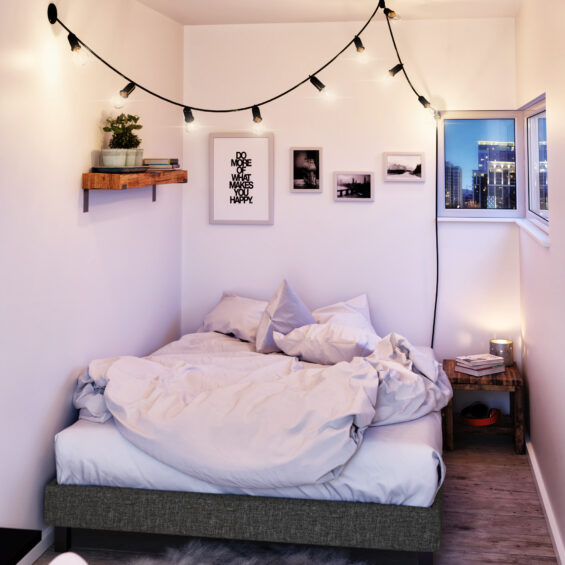
A small bedroom can feel cramped… unless you know how to make every inch work for you. With thoughtful planning and the right furniture, a small space can become a cozy, stylish, and deeply comfortable retreat. Here’s how to transform even the tiniest bedroom into a functional and restful sanctuary.

1. Choose multifunctional furniture

In a small room, furniture needs to work double duty.
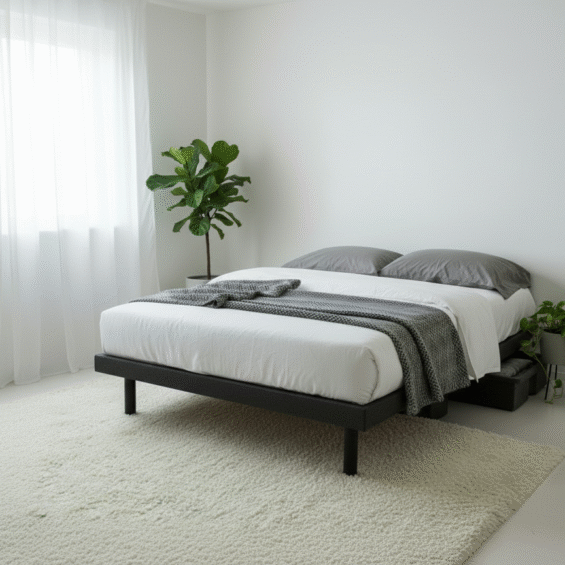
A platform bed with built-in storage is one of the best ways to free up floor and closet space. Under-bed drawers can hold linens, clothing, or accessories while keeping the room neat and uncluttered.

2. Define zones creatively

Even in compact spaces, visual structure matters.
Use a rug, a slim shelf, or a slight change in wall color to subtly distinguish the sleeping area from a workspace or reading nook. This organization helps the room feel larger and more purposeful.

3. Use vertical space to your advantage

When floor space is limited, look up!
Wall shelves, minimalist bookcases, hooks and vertical storage can free the floor and create a lighter, more open feel.

For very small bedrooms, a loft-style bed — or even a slightly elevated base — can create precious usable space underneath.

4. Choose light colours and soft lighting

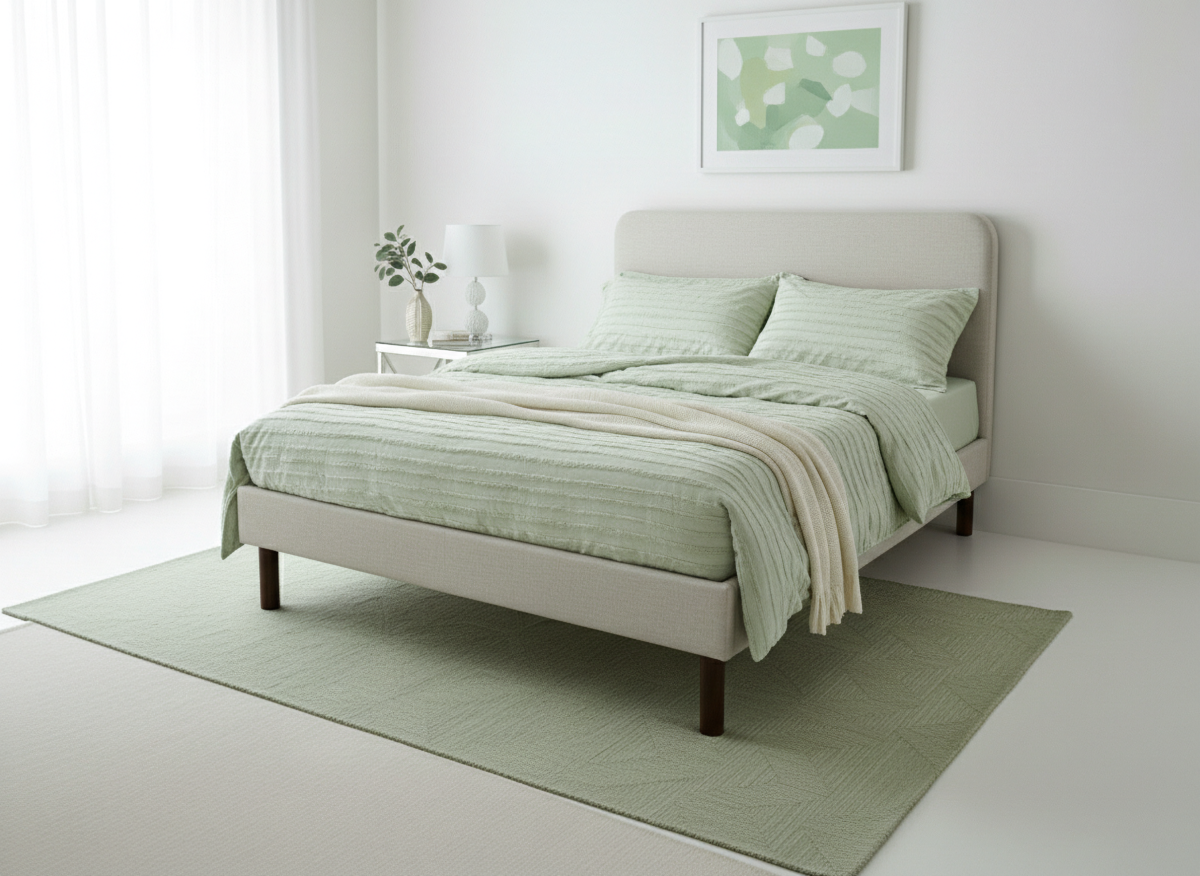
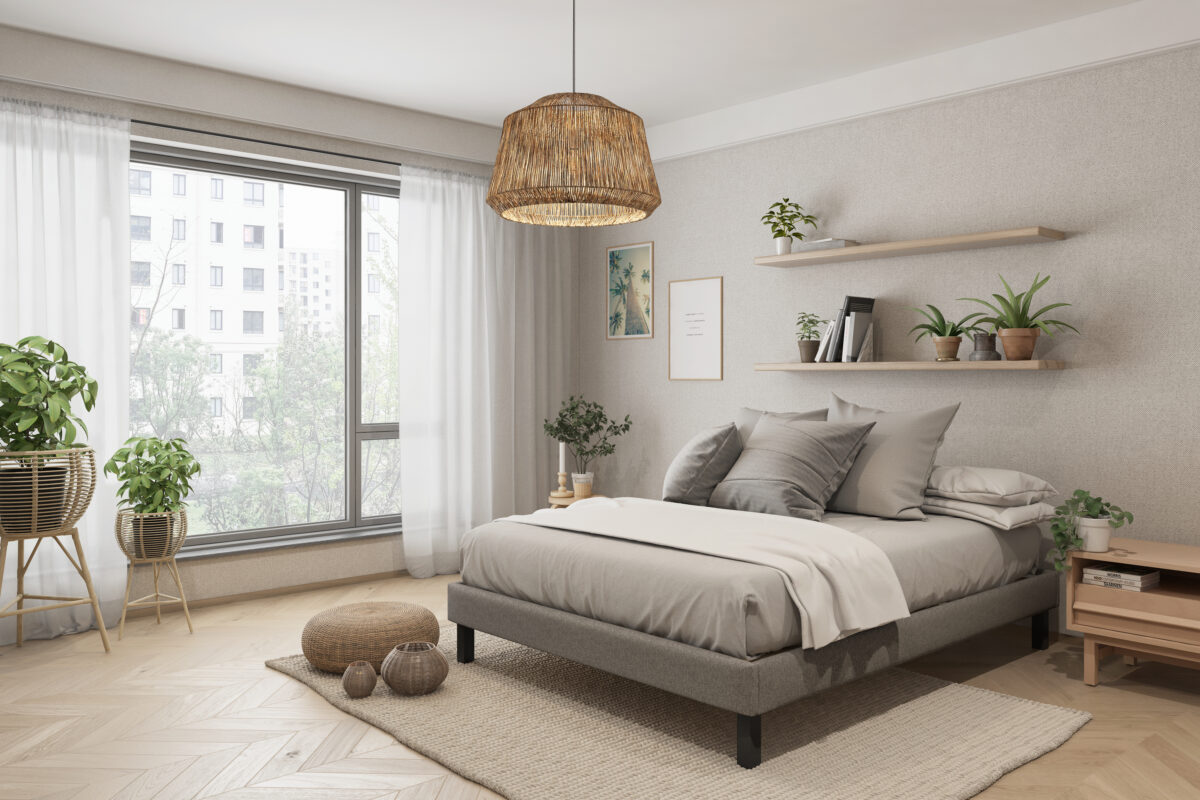
Soft hues like off-white, beige, sage or pastels help visually expand the room while creating a calming atmosphere, ideal for sleep.

Pair them with warm, layered lighting: wall sconces, pendant lamps or subtle LED strips. These solutions save space and add elegance.

5. Pick a bed base and bedding suited to small spaces

An oversized bed quickly overwhelms a small bedroom. To maximize comfort and circulation:

  • choose a platform base or compact adjustable bed;

  • avoid bulky designs;

  • use light-coloured bedding and breathable fabrics.

A well-designed bed base maximizes both space and support — even in tight quarters.

6. Smart storage: the secret to a comfortable small room

Under-bed drawers, decorative boxes, vertical units, baskets… anything that reduces clutter instantly improves how the space feels. A tidy room is a restful room.

In a nutshell

Optimizing a small bedroom is all about smart choices: multifunctional furniture, vertical thinking, soothing colours and efficient storage. With the right bed base, especially one with built-in storage, even the smallest bedrooms can feel spacious and deeply comfortable.

How to Know if Your Bed Is Causing Your Morning Aches?

Do you wake up feeling stiff, sore, or like you didn’t rest at all? Before blaming age, stress, or your posture, consider this: your bed might be the real culprit.

Here’s how to tell if your mattress or bed base is responsible for your morning discomfort and what you can do about it.

1. Your mattress sags or feels uneven

Look for:

  • dips where you sleep,

  • lumps,

  • or areas that feel uneven or slanted.

This means the mattress has lost its structure, forcing your muscles to work all night to compensate.

2. Your pain fades as the day goes on

If your morning back, hip, or shoulder pain gradually disappears during the day, it’s often a sign your bed isn’t supporting your body properly.

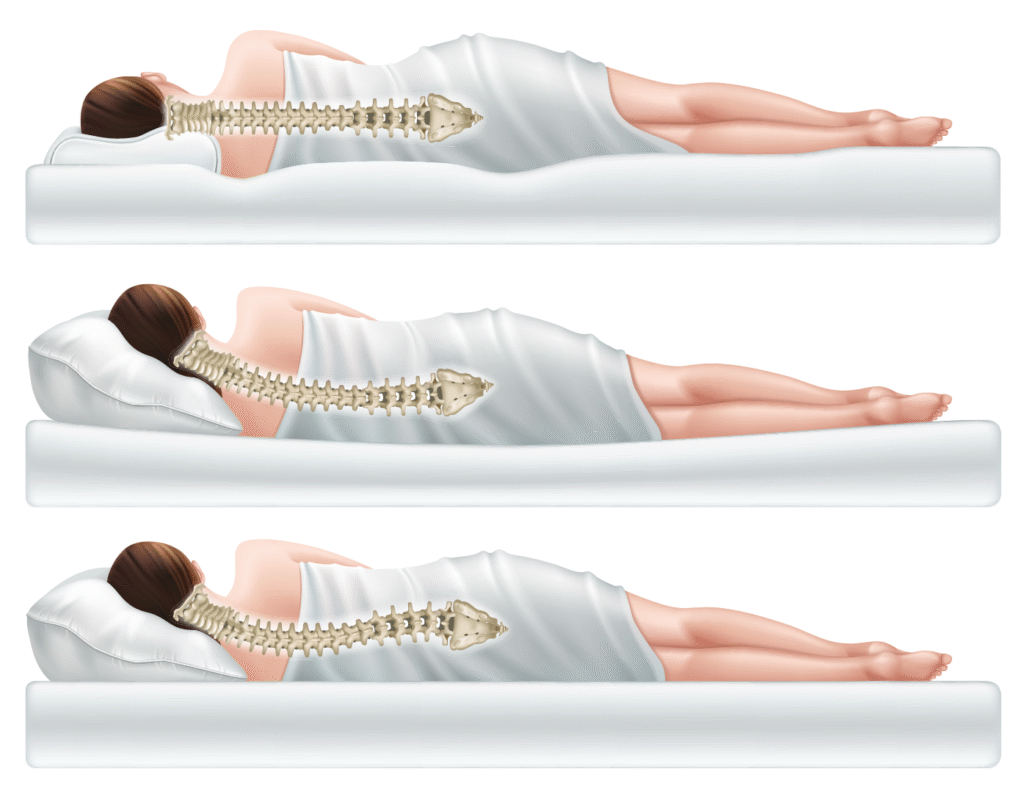
A proper bed should maintain natural spinal alignment, as outlined in our alignment guide.

3. You toss and turn constantly

Movement during sleep is normal, but constant repositioning usually signals discomfort. If you can’t find a stable position, your mattress may not be distributing pressure correctly.

Different sleep positions need different kinds of support, as our sleeping positions guide explains.

4. Your bed base is worn or unstable

The mattress isn’t always the problem, sometimes it’s the base underneath. A weak, noisy, or uneven base can compromise the entire sleep setup.

A solid base distributes weight evenly and helps with proper alignment. A platform such as the Level or Reflexx, or even an adjustable base, can make a huge difference.

5. You sleep better… elsewhere

If your back feels great after a night at a hotel, a guest room, or even your sofa, it’s a very strong sign your bed at home is failing you.

6. Your bed doesn’t match your current needs

Your body changes, your bed should adapt. For example:

  • Acid reflux and circulation issues benefit from adjustable bases.

  • The Zero-G position can ease lower-back pressure.

  • Side sleepers often need softer comfort at the shoulders.

7. Your mattress is more than 7–10 years old

Even a good mattress has a limited lifespan. After 7 to 10 years, the materials lose some of their resilience, especially if the support wasn’t optimal to begin with.

Of course, some mattresses last longer, but it is better to pay attention to the signs than to end up with painful mornings.

How to fix the issue

✔ Evaluate your bed base

A new platform or adjustable base can completely change your comfort.

✔ Choose a mattress suited to your sleep style

Firmness, posture, and body type matter.

✔ Think in terms of a system

Mattress + bed base = one team.

✔ Test before you buy

Your body will be your best guide.

In short

If your mornings start with pain, your bed might be the culprit and the good news is, you can change that. A well-supported sleep is not a luxury. It’s something you feel every single day.

.

The Art of Slowing Down: Turning Your Bedroom into a Stress-Free Sanctuary

Life moves fast. Really fast. Between work, notifications, commitments, and the constant noise of everyday life, we often forget to simply… breathe.
But what if your bedroom could be more than just a place to sleep? What if it became a true refuge, a space to recharge, unwind, and slow down?

1. Slowing down starts with a soothing space

The art of slowing down begins with your surroundings.
Your bedroom is one of the most intimate rooms in your home, a place where you can disconnect from the world and reconnect with yourself.

Choose soft, natural tones like beige, sand, sage green, or pale blue. These colours encourage relaxation and signal calm.
Add natural elements — a leafy plant, a wooden lamp, or a linen throw — and let your space breathe.

Fewer objects, more meaning. A well-chosen bed, quality bedding, and a clutter-free space can instantly transform your room’s atmosphere.

2. The heart of your haven: a bed that supports your well-being

A good bed isn’t just about comfort, it’s the foundation of real rest.
A solid bed base and the right mattress work together to keep your body properly aligned, reduce tension, and help your mind relax.

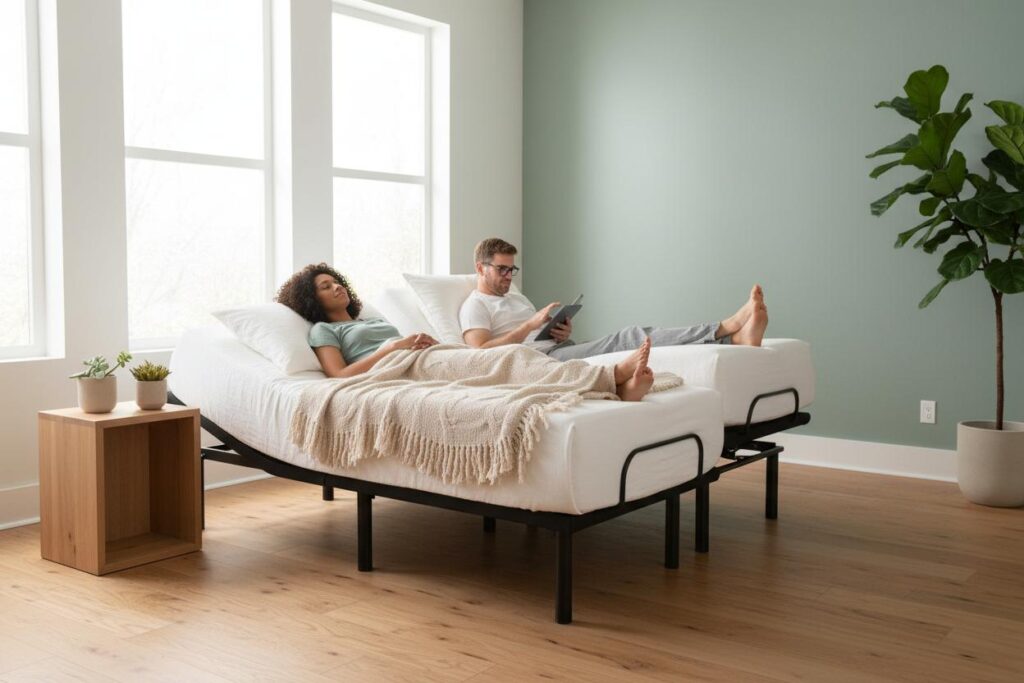
For an even more personalized experience, an adjustable bed base lets you find the perfect position for reading, meditating, or simply doing nothing at all.

At Beaudoin, we believe your bed should adapt to you, not the other way around. Our adjustable and upholstered bases combine design and comfort, so your bedroom remains both beautiful and restorative.

3. The power of evening rituals

Transforming your bedroom into a sanctuary is also about slowing down your pace before bedtime..
Turn off screens at least an hour before bed.
Dim the lights.
Light a candle, enjoy a quiet read, and listen to calming music…
These simple gestures signal to the body that it can slow down.

This moment then becomes a rendezvous with yourself, a pause in time, a gentle breath where everything stands still.

4. Simplicity is the new luxury

Slowing down doesn’t mean doing less, it means doing better.
It’s about being intentional with what you bring into your space and keeping only what truly adds value.

A thoughtfully designed room, natural materials, and a comfortable bed create a quiet kind of luxury, one that soothes the senses and restores balance.
True comfort isn’t measured by how much you have, but by how calm you feel.

In summary

Slowing down is an art, and it often begins in the simplest room of the house: the bedroom.
With a well-chosen bed, soft lighting, and peaceful rituals, you can turn your space into a sanctuary for both body and mind.

Because when you give yourself permission to rest, you don’t just recharge — you reconnect with yourself.

Finding the Perfect Height for Your Bed

We often talk about the mattress, but rarely about the base that supports it. Yet the bed base height directly impacts your comfort, proper mattress ventilation, and the overall harmony of your bedroom. When chosen wisely, it makes getting in and out of bed easier, extends the life of your bedding, and enhances your sleep space. Here’s how to find the height that truly suits you.

Let the mattress breathe

A mattress needs air to stay fresh. Too close to the floor, moisture can build up and shorten its lifespan. Around 6 inches of clearance under the base allows air to circulate, prevents odors, and reduces the risk of mold.

Make getting in and out easy

Height plays a key role in how easily you can get into and out of bed.

  • Too low, and you strain your knees and back.
  • Too high, and it can feel awkward to use.

Ideally, your feet should rest flat on the floor when you’re sitting on the edge, without effort to stand up.

Create the perfect look

The height of the base also affects the overall style of your bedroom.

  • Low bases: modern, minimalist look
  • Higher bases: elegant style with a strong presence

Choosing the right proportion ensures your bed works harmoniously with your furniture and desired ambiance.

Go for adjustability

Some models allow you to change their height with removable or interchangeable legs. This is a practical solution for adapting the bed to your changing needs or updating the look of your room without replacing the entire base.

Test before you buy

To be sure about your choice, simulate the ideal height. A simple chair can serve as a reference: sit down, stand up, and evaluate the movement. If it feels smooth and natural, you’re on the right track.

In short

Bed base height is more than a style choice. It’s a key factor for your comfort, your mattress’s health, and the visual balance of your bedroom. Taking the time to choose wisely is an investment in better sleep and a more pleasant everyday space.